


Lifelong learning for the entire coffee value chain
The coffee industry needs more than professionals who excel at a single skill. To adapt to changes in technology, markets and sustainability expectations, learners need to understand how craft, business, data, research and community are connected.
AI Coffee Academy is positioned as an academy for education, AI, research and professional development across the coffee ecosystem. Rather than separating the classroom from real-world practice, ACA envisions a learning journey in which knowledge can be tested, applied, exchanged and continuously developed throughout every stage of a career.
A program may end, but the journey of developing professional capability continues beyond the classroom.

Seven connected capabilities, one learning journey
The ACA ecosystem is structured around seven connected capabilities. Each serves a distinct purpose while contributing to a shared objective: helping learners move from professional foundations to technology application, research, industry engagement and active participation in a wider community.
1. Coffee School - Building professional foundations
Coffee School focuses on the essential capabilities of the coffee industry, from practical craft and specialist knowledge to executive education. It provides a foundation for learners to understand coffee products, processes, quality and their own role within the value chain.
Its learning pathways respond to different development needs, from people beginning their coffee journey to specialists, managers and business leaders.
2. Digital Learning - Expanding access to knowledge
Digital Learning extends the learning experience beyond the boundaries of a fixed classroom. LMS platforms, microlearning, virtual classrooms and digital forms of capability recognition make knowledge more accessible while helping learners continue reviewing and developing after each program.
Learning technology does not replace human interaction. Its role is to create additional touchpoints so that knowledge can be accessed at the right time and in ways that better support different learning journeys.
3. AI Innovation Lab - Exploring technology through real challenges
AI Innovation Lab connects data, professional craft and business thinking to explore practical AI applications for coffee. Its areas of exploration include AI for Coffee, AI Marketing, AI Barista, AI Operations and Business Analytics.
The starting point is not the tool, but the challenge that needs to be understood. Technology creates value when it helps people interpret data, improve decisions and support their work without diminishing the importance of professional experience.
4. Coffee Research Center - Turning questions into knowledge
Coffee Research Center creates space for questions about quality, new products and sustainable development to be approached systematically. Research connects real-world observations with data, methods and a process of careful evaluation.
Through this process, knowledge can move beyond theory and become a foundation for education, innovation and deeper dialogue across the industry.
5. Industry Partnership - Bringing practice into education
Industry Partnership serves as a bridge between ACA and enterprises, coffee chains, roasters, farms, equipment suppliers and other participants across the coffee value chain. These connections allow real needs and operational challenges to inform educational and research conversations.
When learning meets real operating contexts, learners can examine a challenge from multiple perspectives. Industry and professional communities can also contribute to discussions about capability needs, technology and questions that deserve deeper investigation.
6. Internship & Career Center - Connecting capability with careers
Internship & Career Center is designed to connect learning with internships, employment, coaching and professional development pathways. It represents an important transition from knowing to doing, and from educational content to the ability to contribute in a specific working environment.
Rather than treating employment as the final destination, ACA sees professional development as a continuous journey in which people regularly update their skills, expand their perspective and identify their next step.
7. Alumni & Global Community - Continuing to learn through exchange
Alumni & Global Community provides space for alumni, experts and community members to continue exchanging knowledge after each program. Seminars, forums and professional networks allow experience to be shared, challenged and renewed as the industry evolves.
Within the ACA × GCA relationship, international connection expands access to diverse perspectives and encourages dialogue among education, business, academia and coffee communities.

Six educational pathways for different professional roles
Within this ecosystem, six high-level educational pathways help learners choose a direction suited to their skills, responsibilities and professional goals:
- School of Coffee Skills: professional craft, processing, sensory evaluation, roasting, brewing and coffee quality.
- School of Coffee Business: business, branding, markets and operations within the coffee industry.
- School of AI & Digital Coffee: AI, data and digital transformation connected to coffee challenges.
- School of Coffee Leadership: leadership, management and the capability to guide change.
- School of Sustainability & Coffee Agriculture: coffee agriculture and sustainable development thinking.
- School of Executive Education: executive education for leaders, managers and decision-makers.
These pathways are not intended to exist in isolation. Professional craft benefits from business thinking; technology needs an understanding of operational context; leadership requires awareness of sustainability responsibilities; and executive education must connect these perspectives to informed decision-making.
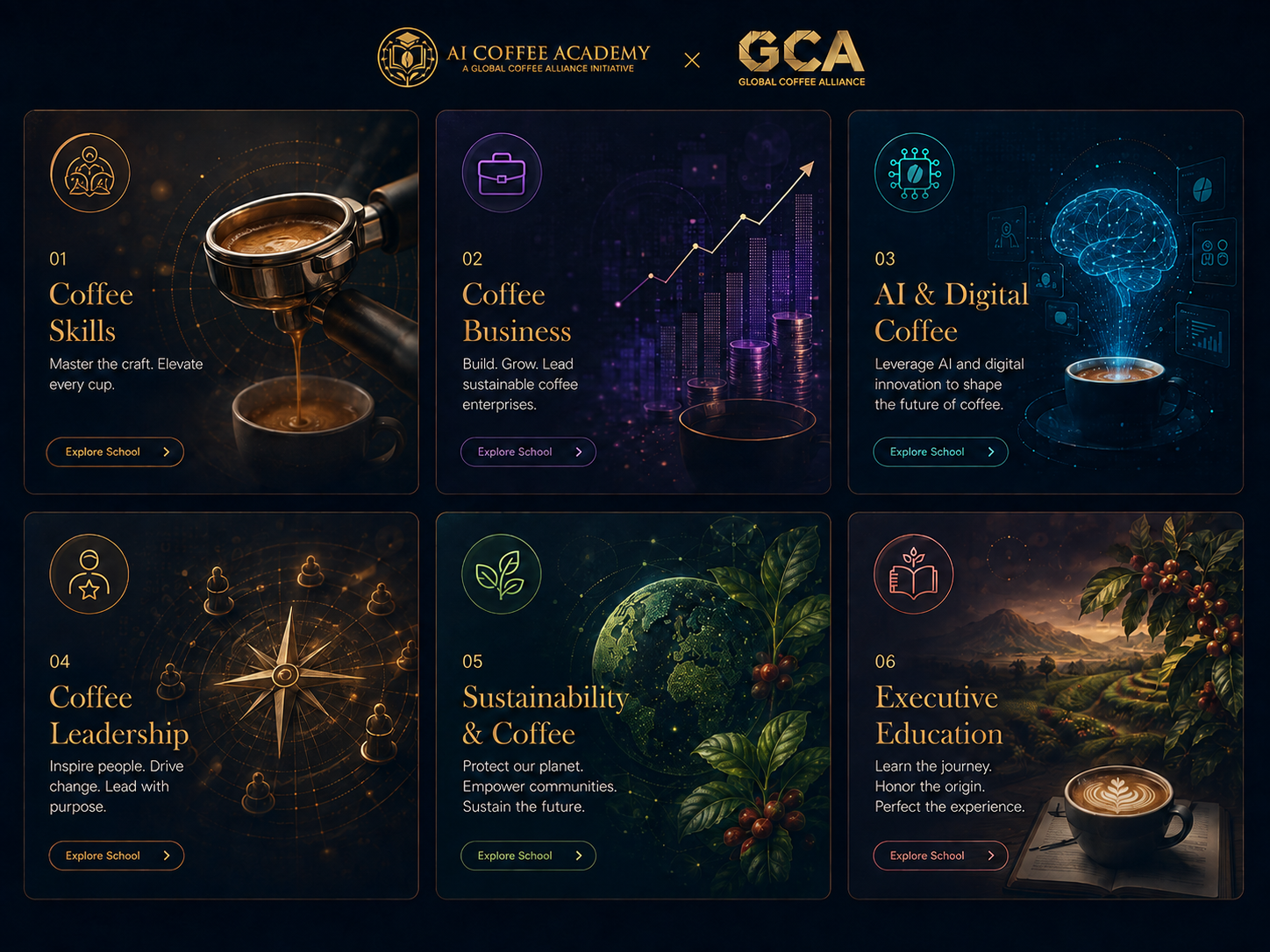 Six pathways connect professional craft, business, technology, leadership, sustainability and executive education.
From learning to the capability to create impact
A learning ecosystem becomes meaningful when its different capabilities actively support one another. A learner may begin with a specific professional skill, expand through digital learning, explore AI and research, apply knowledge in a professional context and eventually share experience with the wider community.
This journey can be understood through five connected stages:
- Build a foundation: understand coffee craft, products, quality and the value chain.
- Expand capability: connect professional skills with business, data, AI, leadership and sustainability.
- Explore and test: bring questions into research, projects and practical contexts.
- Develop professionally: connect capability with internships, work and long-term career pathways.
- Contribute back: share experience, participate in the community and help enrich a collective body of knowledge.
Technology in service of people
Within ACA’s direction, AI and digital platforms are not independent destinations. Technology should serve people, support professional expertise and help participants across the coffee value chain understand information more clearly.
This requires learners to do more than operate a tool. They must understand the problem, evaluate data, recognise limitations and consider the effects of each decision. Professional experience, critical thinking and responsibility to the community remain fundamental to meaningful innovation.
A learning journey without a final endpoint
ACA envisions an ecosystem in which education, technology, research, industry, careers and community all contribute to capability development. Each component offers a different point of entry, but they meet around the learner and the ability to create value in practice.
With these connections, the classroom is no longer an isolated experience. It becomes the beginning of a longer journey: learning to understand, practising to grow, and sharing so that knowledge can continue to expand and contribute to the future of coffee.